
Earlier insights.
Earlier intervention.
Xenter Diagnostics puts advanced cognitive assessment technology where it matters most: at the point of care.

of patients want to know about cognitive decline.
Alzheimer’s Association
When it comes to cognitive health, earlier understanding can make all the difference.
Built on a foundation of data, validation, and continuous improvement, Xenter deploys technologies to support informed clinical decision-making, helping frontline clinicians identify and manage cognitive decline with greater confidence.
99% of Americans 40+ say brain health is as important as, or more important than, physical health.1
Yet only 9% report knowing a lot about maintaining their brain health.1
Detect it early
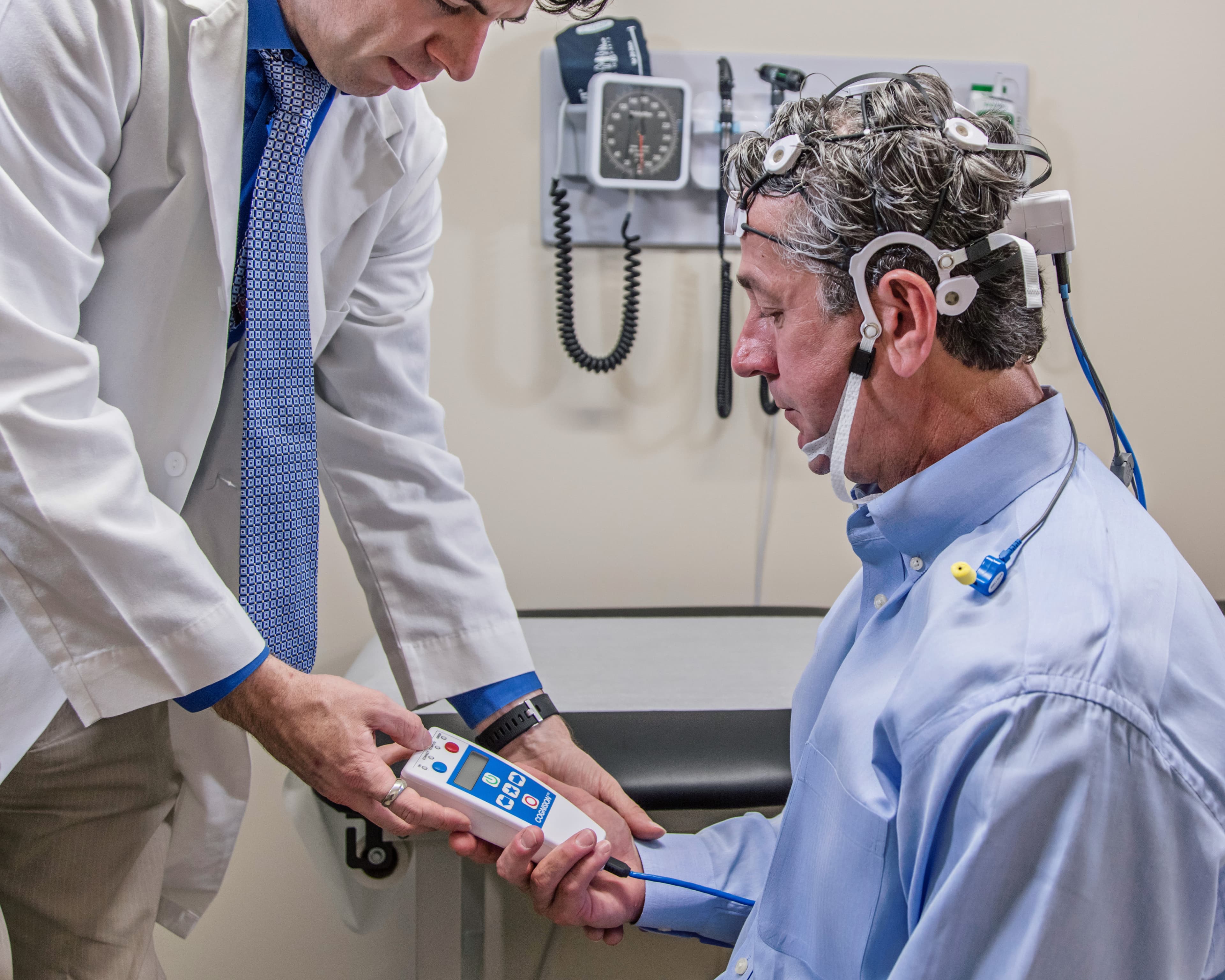
Research has shown that Event-Related Potential (ERP) testing can detect cortical changes associated with Alzheimer’s disease up to 10 years before expected symptom onset.3
Open the door to treatment
Only patients diagnosed with Mild Cognitive Impairment (MCI) qualify for disease-modifying therapy. Today, just 8% of MCI patients receive a timely diagnosis, meaning most never reach treatment at all.4
Give your patients more time
As disease-modifying therapies become available for eligible patients with early Alzheimer’s disease, objective screening can help identify patients who may benefit from further evaluation and timely treatment discussions, when early intervention may have the greatest impact.5
79% want to know if they have Alzheimer’s disease before experiencing symptoms.2
«Expand cognitive assessment with two complementary measures
EEG / ERP Brain Activity Test
Provides an objective assessment of brain function by measuring electrophysiological responses associated with attention, information processing, and working memory.
Blood Biomarker Panel
Measures plasma biomarkers associated with Alzheimer’s disease pathology, providing objective biological insight that complements functional assessment.
Alzheimer’s disease biomarker changes may be detectable years, often decades, before clinical symptoms emerge.6
Complementary objective measures, one assessing pathology, the other assessing brain function6,7, to support more informed clinical decision-making.
Simple workflow
No upfront costs
No capital equipment required.
No staff required
Fully supported service.
Objective data
Unbiased, reproducible measures.
Neurologist-developed program
Clinical report provided.
Incorporates an FDA-cleared cognitive assessment device included in the Alzheimer’s Association Cognitive Assessment Toolkit.8,9
Established CPT pathways.
| CPT | Description |
|---|---|
| 92552 | Pure Tone Audiometry |
| 92652 | Auditory Evoked Potentials |
| 95816 | Routine EEG |
| 95957 | EEG Digital Analysis |
| 99483 | Cognitive Assessment and Care Plan |
*Providers should confirm the appropriateness and coverage of each CPT selection with their billing team.
Common ICD-10 indications: memory loss/forgetfulness (R41.3, G31.84), confusion or trouble concentrating (R41.82, R41.89), dizziness (R42, R55), and history of head injury (S06.0X0A). Note: Routine EEG (95816) coverage excludes select indications such as anxiety, ADHD, depression, autism, learning disorders, schizophrenia, and substance use - documentation should reflect a cognitive complaint, if applicable.
Peer-reviewed research
Access peer-reviewed research papers supporting our cognitive diagnostics methodology.
* Providers should confirm the appropriateness and coverage of each CPT selection with their billing team.
Schedule a workflow walkthrough and reimbursement review for your practice.
References & disclosures
- Alzheimer’s Association. 2026 Alzheimer’s Disease Facts and Figures. 2026.
- Alzheimer’s Association. 2025 Alzheimer’s Disease Facts and Figures. April 29, 2025.
- Golob EJ, Ringman JM, Irimajiri R, et al. Cortical event-related potentials in preclinical familial Alzheimer disease. Neurology. 2009;73(20):1649-1655.
- Alzheimer’s Association. 2025 Alzheimer’s disease facts and figures. Alzheimers Dement. 2025;21(5).
- Skaria AP. The economic and societal burden of Alzheimer disease. Am J Manag Care. 2022;28(10 Suppl):S188-S196.
- Jack CR Jr., Amariglio RE, et al. Criteria for diagnosis and staging of Alzheimer’s disease. Alzheimer’s & Dementia. 2024;20:e13809.
- Olichney JM, et al. Event-related potentials as biomarkers of Alzheimer’s disease and MCI. Frontiers in Aging Neuroscience. 2022.
- Alzheimer’s Association. Cognitive Assessment Toolkit. Accessed June 26, 2026.
- COGNISION INDICATIONS FOR USE: The COGNISION System is for use by qualified clinical professionals in private practice offices or small clinical settings for the acquisition, display, analysis, storage, reporting and management of electroencephalograph (EEG) and auditory evoked potentials (AEP) information.
This information is intended for healthcare professionals only and is not medical advice. The Xenter Cognitive Assessment is intended to support clinical evaluation by a qualified healthcare provider. (c) 2026 Xenter. All rights reserved. All other trademarks are the property of their respective owners.